Enterprise Resilience Software
Enterprise Resilience Is a Decision Problem
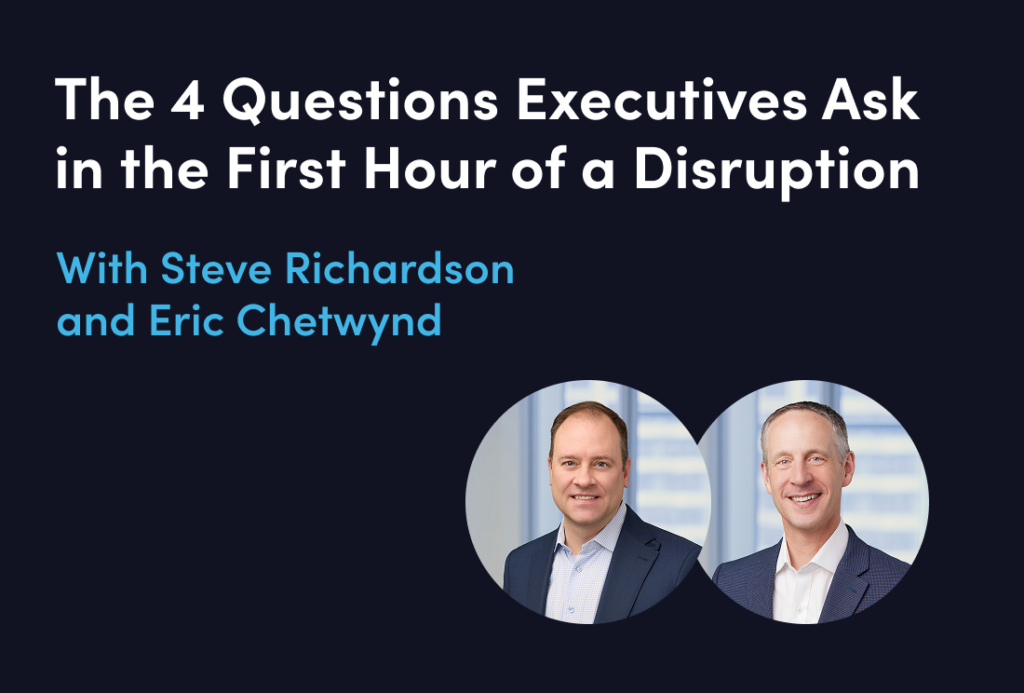
Most large organizations cannot answer four questions at decision speed when disruption hits: what is impacted, what happens next, what is the financial exposure, and what should be prioritized first. Fusion is purpose-built to answer them.
Fragmented Resilience Programs Create Costly Delay
Many organizations manage continuity, technology, risk, crisis, and third-party programs separately. Each program relies on its own data, plans, and assumptions.
Enterprise resilience connects these programs around shared data, dependencies, and decisions. It gives leaders the operating capability to quantify disruption exposure, protect financial performance, and make confident decisions before and during disruption.
When disruption crosses functional boundaries, teams can lose critical time reconstructing dependencies, clarifying ownership, and reconciling plans. Those delays can increase the financial impact.
50%+
of total disruption loss is driven by delays in detection, decision-making, and recovery coordination.
1.3x–2.4x
amplification of base disruption impact from manual triage, ownership confusion, and dependency uncertainty.











How Fusion Turns
Dependencies Into Decisions
Fusion’s Enterprise Resilience Decision System connects critical services to the processes, technology, suppliers, facilities, and teams they depend on. From one continuously curated service-and-dependency model, leaders can identify exposure, model impact, and prioritize the best course of action before and during disruption.
Explore the Platform-
Expose
See What Is at Risk
Identify critical services, concentrated exposure, and the dependencies that matter most.
-
Model
Understand What Happens Next
Test scenarios, trace cascading effects, and quantify operational and financial exposure.
-
Optimize
Decide What to Prioritize
Compare trade-offs and focus mitigation, response, and recovery on the highest-value actions.
Move from Documentation to Decisions
See where shared data, scenario modeling, and coordinated action are working,
where manual effort remains, and what the next stage requires.
Trusted by Enterprise Resilience Leaders
View all customer stories30–50%
Faster Recovery
Reduction in time-to-recovery across critical business services.
75%
Response Efficiency
Increase in incident response efficiency across cross-functional teams.
80%
Executive Confidence
Faster, more accurate response to executive questions during active events.


See the Fusion Enterprise Resilience Decision System in Action
Bring a critical service, disruption scenario, or exposure question. We’ll show how Fusion connects dependencies, quantifies exposure, and helps teams agree on what to prioritize.